The Real Risk of Elevated Permissions in Power Automate
Diesen Beitrag auf Deutsch lesen
Once a flow runs with a service account's elevated rights, the flow's own input validation becomes the last line of defense — not the caller's permissions.
TL;DR
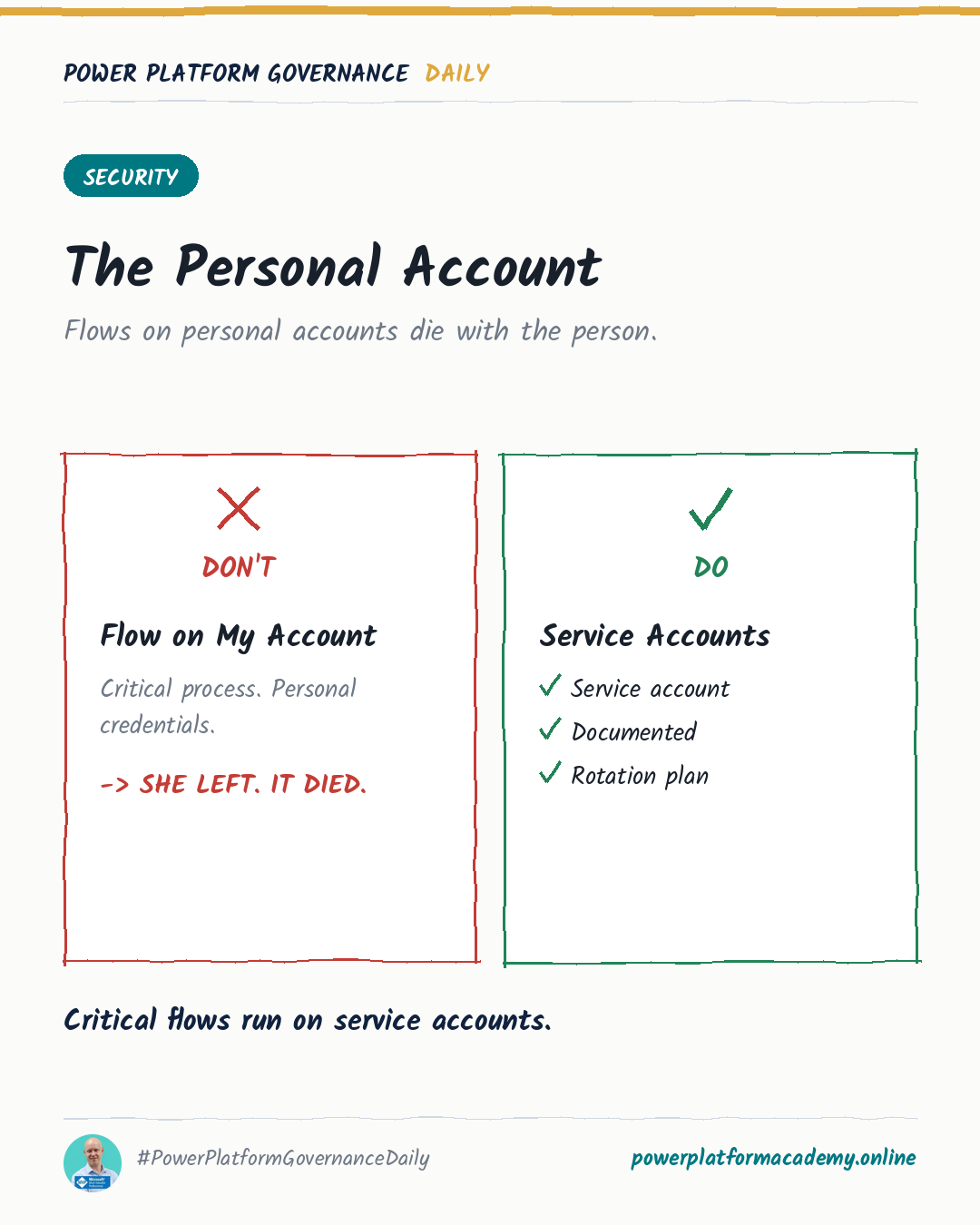
Once a flow runs with a service account’s elevated permissions, the flow’s own input validation — not the calling user’s access rights — becomes the only real safety check, so scope that account to exactly what the flow’s actions need rather than broad admin access, and add explicit audit logging for sensitive operations since run history alone may not satisfy compliance.
Original by Marcel Lehmann, on PowerPlatformTip. Read the original
This is our own summary, not a republication or full translation. Both publications are edited by Marcel Lehmann.
Governance takeaway
- Makers: building a flow that runs under a service account’s elevated rights need to validate every input inside the flow itself, since the caller’s own permissions stop mattering the moment the flow takes over.
- Admins/CoE: scope that service account to exactly what the flow’s actions require, not broad admin access, so one validation gap doesn’t turn into a tenant-wide one.
- Security/Compliance: require explicit audit logging on sensitive operations here, since standard run history alone may not hold up as evidence in a compliance review.
Frequently asked questions
Why can a user without SharePoint write access still create list items through a flow?
A flow connection belongs to whoever configured it, not to whoever triggers the flow.
What is the main security risk of this permission elevation pattern?
The flow becomes your security boundary, because it runs with the service account's permissions regardless of which user triggered it. The end user never directly accesses the restricted resource.
How much access should the service account behind an elevated flow get?
Only the specific permissions the operation needs, for example write access to a restricted SharePoint list or update rights on a Dataverse table. The article advises least privilege, not broad admin access.