Govern a Generic Custom Connector Before Sharing It
Diesen Beitrag auf Deutsch lesen
A dynamic Custom Connector centralizes API authentication, but DLP governs the entire connector rather than individual endpoints.
TL;DR
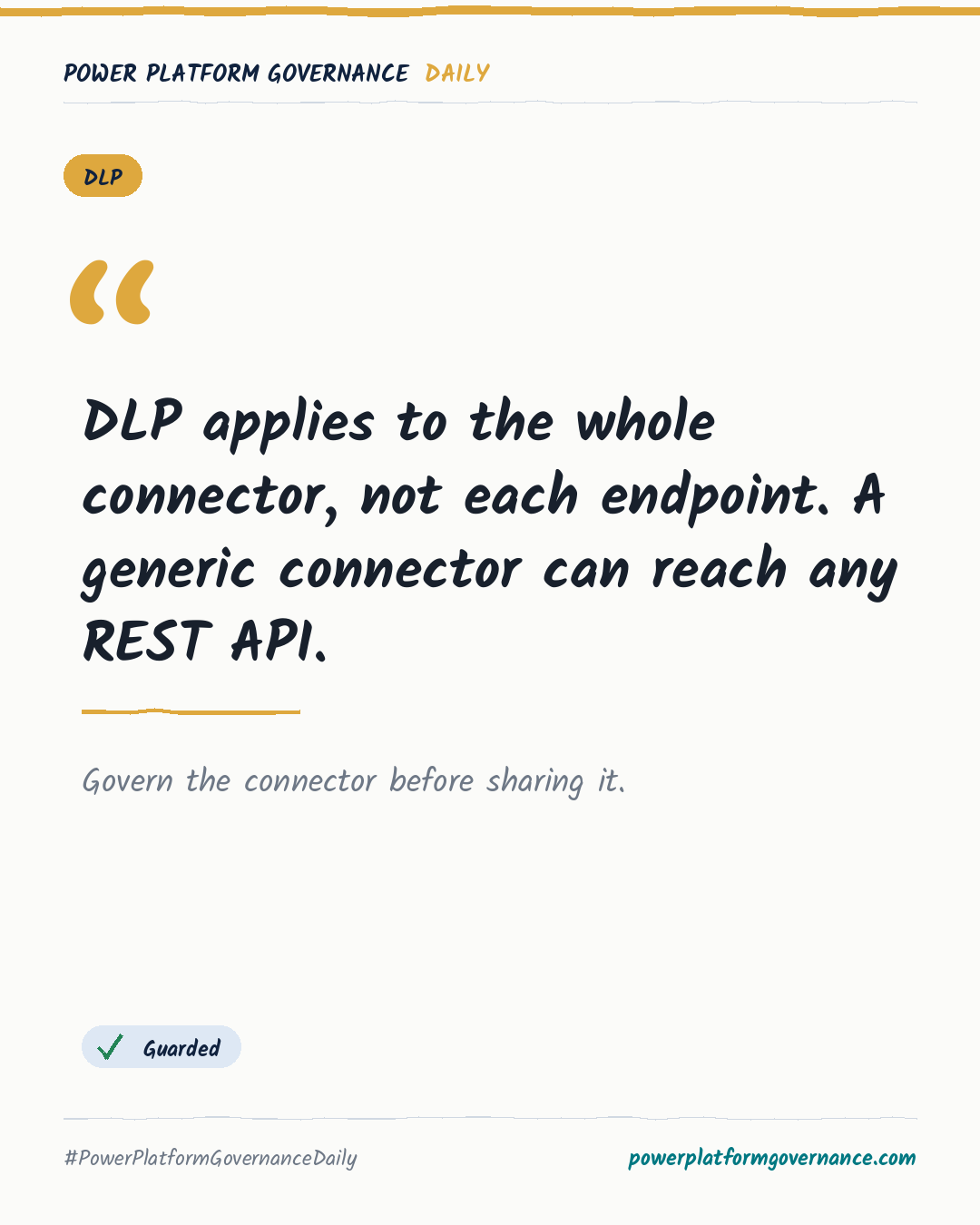
A Custom Connector can store an API key on one encrypted connection and expose generic actions that receive relativePath, query and body at runtime. DLP applies to the whole connector, so a connector capable of reaching any REST API should be governed before productive sharing.
Original by Marcel Lehmann, on PowerPlatformTip. Read the original
This is our own summary, not a republication or full translation. Both publications are edited by Marcel Lehmann.
Governance takeaway
- Makers: Pass relativePath, query and body to the generic action, while the shared connection keeps the API key out of flow logic.
- Admins/CoE: Classify and govern the entire connector before rollout, because its dynamic design can reach any REST API.
- Leadership/Business: Account for Premium rights for every user running a flow or app that uses the connector.
Frequently asked questions
How does a Power Platform Custom Connector keep an API key out of flows?
The API key is entered once on the encrypted connection, while flows send only the relative path, query and body.
How does DLP apply to a generic Custom Connector with dynamic endpoints?
DLP applies to the entire connector rather than individual endpoints. A generic connector can reach any REST API, so trusted sharing is required.
How can a Custom Connector call nested API resources such as projects and tasks?
Path parameters encode slashes, so nested resources need a separate parameterized action or URL rewriting through custom connector code.